AI Is Destroying Average Work First
AI is not replacing all humans. It’s replacing predictable output. That includes generic writing, repetitive designs, basic coding, shallow research, low-level support tasks, and formulaic content.
In simple terms: If your work looks like it can be generated in 30 seconds, you are entering dangerous territory.
This is why so many industries are panicking. Because AI compresses execution. Things that once took days, teams, or specialized knowledge can now happen instantly.
The internet is about to be flooded with average content, average products, average businesses, and average ideas. Which creates a new problem: Attention becomes harder to earn. Trust becomes harder to build. And originality becomes more valuable.
The Value of “Doing” Is Decreasing
This is the part many people still don’t understand. Execution is getting cheaper. Thinking is becoming more valuable.
For years, people were rewarded simply for making graphics, writing posts, editing videos, building websites, or producing information. Now AI can assist with all of that. So the value shifts upward.
The future rewards people who can think strategically, ask better questions, make better decisions, combine ideas creatively, and understand human psychology. The advantage is no longer just creation. It’s direction.
The Internet Will Become Extremely Noisy
We are entering the era of synthetic abundance. Meaning: infinite content, infinite opinions, infinite designs, infinite media, infinite automation. The barrier to creating online is collapsing. That sounds exciting. But it also means the internet will become crowded with low-effort output.
You’ll see cloned brands, recycled ideas, fake expertise, AI-generated personalities, and endless content farms. The internet may become more productive — but also less trustworthy. And when trust drops, human credibility becomes premium.
Human Taste Will Matter More Than Ever
Ironically, AI may make human judgment more valuable. Because when everyone can generate endless output, people start asking: “What’s actually good?” That’s where taste, curation, perspective, and discernment become powerful.
Anyone can generate 1,000 ideas. Very few people can recognize the one worth building. This is why creative directors, strategists, curators, storytellers, and visionary thinkers will become even more important. AI can generate options. Humans still decide meaning.
Personality Becomes a Competitive Advantage
Most AI-generated content feels emotionally empty. Technically correct. But forgettable. The future internet may become flooded with polished mediocrity.
Which means authenticity, personality, humor, emotion, storytelling, and lived experience become differentiators. People will increasingly follow humans who feel real, relatable, insightful, and trustworthy. Not just informative.
This is why personal branding becomes more important in the AI era — not less. People trust people.
Communities Will Become More Valuable
As AI-generated content explodes, people will search for belonging, human interaction, trusted spaces, and real conversations. Communities may become one of the strongest forms of digital leverage. Because algorithms can distribute content. But communities create connection.
This is why niche communities, creator ecosystems, private groups, membership networks, and collaborative platforms will continue growing. In an AI-heavy world, human connection becomes scarce. Scarcity creates value.
The New Divide Will Not Be AI vs Non-AI
That’s outdated thinking. The real divide will be: People who know how to leverage AI versus people who become dependent on it. There’s a difference.
Some people will use AI to amplify creativity, increase speed, build systems, learn faster, and create opportunities. Others will slowly lose the ability to think deeply, write clearly, solve problems, or create independently. That dependency will become dangerous. Because tools evolve. Platforms change. Algorithms shift. Foundational thinking still matters.
Education Is About to Be Disrupted Hard
Traditional education systems move slowly. Technology moves violently fast. By 2030, many schools may still be teaching outdated systems while the digital economy evolves in real time. People are increasingly learning through YouTube, AI tutors, online communities, digital courses, creators, and practical internet experience. The monopoly on knowledge is collapsing.
But there’s a catch: Access to information is no longer the advantage. Execution is. Everyone can learn almost anything online now. Very few people apply what they learn consistently.
Jobs Will Change Faster Than People Expect
Some jobs will disappear. Some will evolve. Entirely new roles will emerge. That’s how technological shifts always work.
But here’s the important part: AI will likely remove more tasks than entire professions. Meaning: a marketer may still exist, but parts of marketing become automated. A designer may still exist, but basic production becomes faster. A developer may still exist, but workflows become AI-assisted.
The people who survive are the ones who evolve alongside the tools. Rigid people struggle during technological shifts. Adaptive people benefit from them.
The Winners Will Combine Human Skills With AI
This is the sweet spot. The future is probably not “humans only.” And not “AI only.” It’s hybrid intelligence.
People who combine creativity, emotional intelligence, strategic thinking, communication, leadership, and AI leverage will become extremely powerful. AI increases capability. Human insight gives it direction. That combination is dangerous in the best way possible.
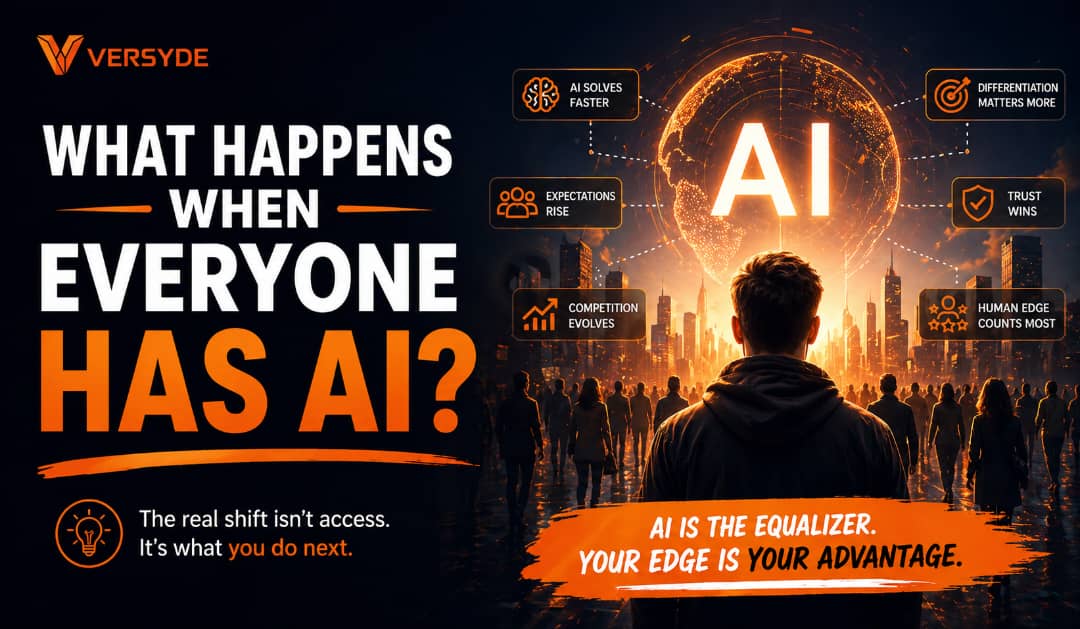
So… What Actually Happens When Everyone Has AI?
Here’s the short answer:
Average becomes invisible. Humanity becomes premium. Execution becomes easier. Originality becomes harder. Content explodes. Trust becomes currency. Speed increases. Depth becomes rare.
And the people who build:
- credibility
- adaptability
- community
- strategic thinking
- and authentic identity
will have massive leverage.
AI is not the end of human value. But it is forcing humanity to level up.
The internet is shifting from “Who can create?” to “Who can think, connect, and lead?” That changes everything.
The people who win in the AI era will not necessarily be the people with the most tools.
They’ll be the people who know what matters, what humans still care about, and how to create value in a world flooded with artificial output.
Leave a Reply